1.0: History Starts Moving
The 1953 era opens. A world with the map, money, armies and voters of that year, a Cold War you play, wars fought at real places on the map, a founding election that gives every nation a mandate its voters chose, and an electorate assembled from real census data. Since launch: a Supreme Court that can move the electorate, war powers and peace deals, three new playable nations, and a rate-setting committee for every central bank. Plus a first look at the next corporation model: sectors you build.
This is the 1.0 milestone. It opens the 1953 era: a world where the map, the money, the armies and the voters all belong to that year. Around it sit the largest systems we have ever shipped at once: a Cold War you play as a board, conflicts that live at real places on the map, and an electorate built cell by cell from real census data. At the end there is a preview of the next big one, a ground-up rework of how corporations produce and sell, which we want you to see before it goes live.
A founding election for 1953
When a 1953 world begins, the game runs a real founding election before anyone takes office. Parties campaign, voters vote, and the winners govern. Every participating country starts from a mandate its voters actually gave it, and your first days in a new world are election days. Later era starts keep their seeded opening governments, so their first government still matches the year selected.
That matters more than it sounds. The strength of every government you will deal with, ally with, or campaign against traces back to a result you can go and look at.
An electorate built from people
Under every election in a 1953 or 1991 world is a new engine. Each state's electorate is assembled from its census: occupation, age, education, religion and urbanization, crossed into thousands of population cells, each with its own positions and its own turnout. The cells are fitted so the totals match what the census counted.
Everything downstream reads those cells:
- •A state leans the way it does because of who lives there. Leans are derived from the population, not assigned. A mill town and a farm county pull differently because their people do.
- •Projections aggregate cells, so they behave. The US House is projected district by district rather than by a national swing, seat forecasts line up with how the map breaks, and no world can report more votes than it has eligible voters.
- •Campaigns meet groups, not averages. Appeal to a position and the cells that share it respond; the ones that do not, do not.
- •It moves with the year. Voting age, the shape of the population and how groups drift all track the live calendar, and every ten years a census redraws House seats and electoral votes.
New worlds run this engine from turn one. Worlds seeded before 1.0 keep their original panels until their next reset.
The world follows the clock
A world's start is anchored to its era. Its behaviour is not. The rule the whole program was built on is gravity, not rails: history pulls, it never steers, and the calendar can never overrule your policy.
- •Crises know what decade it is. Cyber, tech-bubble and disinformation crises arrive when a world's live year reaches them, whatever year it was seeded in. Pandemics can strike any era; the 1957 Asian flu killed over a million people.
- •Prices and exchange rates start where the era started, then move on their own.
- •Statehood is a live process. Territories build pressure inside era windows and are admitted with their seats, offices and elections attached.
- •Copy is checked against the decade. Legislation text and player events that are wrong for their year fail a lint before they ship.
1953 is a year the game understands
Both the 1953 and 1991 starts are fully playable. The economy behaves like its decade, the electorate is built for it, and the map is the map of that year. Alaska and Hawaii are territories, because they did not join until 1959.
The clearest way to see it is where the power sat.
Electoral votes, by era start
A 1953 campaign is a different campaign because of that, and nobody has to tell you so. It falls out of the era's real apportionment.
The Cold War is a board you play on
The largest single piece of work in the release. Alignment is a system with a ledger, a price, an opponent, and consequences.
Where everyone stands
Every nation carries a share for each bloc plus an uncommitted remainder, always totalling 100, seeded from an authored table covering 199 entities, colonies and protectorates included. The Cold War Ledger under World lists every nation's shares, lead, trend and band.
Sweden and Yugoslavia both look neutral at a glance. Sweden is genuinely undecided; Yugoslavia is being pulled hard in two directions. A single left-or-right number cannot tell you that. The ledger can.
Which poles exist depends on the live year. 1953 is West against East, the Non-Aligned Movement becomes a pole in 1961, and from 1991 the board is Washington, Moscow, Beijing and non-aligned. The threshold to join scales with how many poles are in play, because a four-way split cannot open a fifty-point lead. Colonies inherit their ruler's alignment and drop to a residual when they gain independence.
Drifting, and changing sides
Nations drift as the game runs, and drift is slow and stubborn. A country deep in one camp barely moves. An uncommitted country is the hardest of all to shift, which is what makes the neutrals worth fighting over. There is a deliberate deadband in the middle where nobody owns a country.
Drift far enough and a nation changes sides for real. Membership follows where a country's sympathies actually went, not who spent money on it most recently. Patronage buys ties and obligations, not loyalty.
Limits, because a system that moves nations around needs them:
- •Non-player nations act on their own. They join and leave under their own judgement.
- •Players are never moved for. A request to a player-run nation asks; it does not act.
- •Alignment governs only the blocs you join by picking a side. Organisations without an alignment channel, the Commonwealth among them, are untouched.
- •A bloc's founders can never be expelled.
- •Non-alignment is the remainder, not a pole. A non-aligned nation has no patron at all. That is the whole point of the movement, which forms in 1961 and can be watched coming into existence mid-run in a 1953 game.
Blocs are not ordinary alliances
NATO and the Warsaw Pact seat the alliances they actually had, and in a Cold War world they are blocs: a defence pact that also pays and squeezes the countries in its sphere.
Bloc membership by era start
Tribute is theirs alone: the members who cannot vote fund the bloc anyway, which is how the two superpowers really ran their halves of the world. Dues charge voting members only.
Influence is a lever you pay for
Every organisation has an Influence tab. A member's foreign minister can spend the bloc's shared fund to pull a nation their way.
The price is a share of the target's own economy, so a hundred million dollars goes much further in a small country than a large one, and no single push can do everything however much you spend. The tab quotes the delivered price, not a list price, and refuses a locked target before taking your money.
Nothing answers you automatically. There is no free counter-move: your rival takes ground back only by spending on it too. Opposing pushes cancel each other before the ceiling is applied, so a contested country resolves proportionally. A country nobody is contesting is cheap; a bidding war over one you both want is expensive.
The tab opens as a situation room. You see how the world splits between blocs, by economy or by country count, then every nation you could court ranked by the question you are actually asking: where is my money cheapest, who is closest to joining me, where is there a crisis, and which of my own members is weakest. Pick one and you get a dossier: where it stands, what is pulling on it, what it costs, and what your rival did to it last turn. You are told which bloc moved a country and by how much, never how much they paid.
A crisis desk lifts a ceiling when a country is in trouble. It lifts the ceiling; it grants nothing. You still have to spend.
Positions track to a tenth of a point, so a modest sustained effort adds up over a year. The alignment screens call countries by the name they had in their era.
Aid pays a member's treasury and buys loyalty at the same time, but only reaches countries already in your bloc, so it holds what you have rather than taking more. Sanctions cost the sanctioner: squeeze a country and your own standing there falls while the embargo lasts. That is a good way to lose a client, and a good trap to walk a rival into.
War is a place on the map
A conflict is a real object: a host country, a region, two sides, and a type, an interstate war, an intervention, a civil war, or a war of independence. Its terrain sets both the combat maths and the kind of enemy you meet, so a jungle war and a war on the plains do not play the same. Armor rolls well across a developed plain and poorly through high passes; amphibious and recon units come into their own in littoral and jungle; open sea belongs to hulls.
Either side can be backed by a bloc, which is what turns a local fight into a proxy war; a conflict nobody backs stays local. Units deploy to a conflict rather than to a fixed front, and sit in the homeland reserve when there is nowhere to be. Doctrine and trait trees shape what your forces are good at. The live Situation Board allocates combat power across those fronts, and Combat Command issues the orders. The conflicts hub shows every live conflict in the world, on the map and in a list, with casualties by theater. The Cold War Ledger carries the wider alignment contest.
Who you can attack is read off the war itself. A conflict knows who is fighting on each side, so the command panel offers exactly the nations across the front you have selected. Alliance membership is read from the actual alliance rolls: the Warsaw Pact roll is the East, NATO's is the West, and a nation in neither pact is non-aligned in fact. In 1953 that includes West Germany, which does not join NATO until 1955. Neutral armies massing read as neutral, not as either side moving.
Armies you have to pay for
- •Eighteen more countries have real armed forces, each with branches that appear and retire on their actual dates. East Germany's NVA runs 1956 to 1990; the Austrian Bundesheer starts in 1955; Czechoslovakia and Yugoslavia retire with the states themselves.
- •Authored orders of battle. What a country fields is what it plausibly fielded, and every roster is calibrated to start inside its own upkeep budget.
- •Recruiting costs real resources. A new unit spends a ministerial action, national manpower, and treasury, priced as a share of your own country's output.
- •Manpower is the hard block. A unit is raised at full strength and costs full strength from the national pool. Disbanding returns the men but not the money, so churn stays expensive.
- •Modernising costs money up front, priced off what the unit would cost to build new and rising as you approach cutting edge. Modern kit also costs more to maintain, deliberately more than the fighting power it adds: a cutting-edge division beats an old one and loses to two of them. Keeping cheap older equipment is a real answer for an army that needs numbers. The button shows both figures before you press it, the price today and the new upkeep.
- •Spending past your surplus is national debt, not an error. The panel shows the split.
Generals
You do not promote a general. They promote themselves by fighting. Experience comes from battles they personally led, so a general who is posted, given units, and sent into an offensive climbs on their own. The corps roster names each officer's rank, specialisation and progress to the next promotion, and their profile is where skill points are spent. Field Marshal is the top of the ladder.
Elections are counted from the map up
- •District-by-district House projections. Seat forecasts line up with how the map actually breaks, not with a national swing.
- •Totals reconcile. A world can never report more votes than it has eligible voters, and crowded races add up correctly.
- •Every race gets a challenger. Wherever the other major party has a real presence, it fields a candidate for Governor and Senate.
- •Presidential primaries run on one engine, and their percentages reconcile to 100.
- •Incumbency and fatigue are real. A sitting leader's advantage scales with their approval, and long-tenured parties pick up a fatigue penalty.
- •Running mates and endorsements. Presidential races outside the US can pick a running mate, and a suspended candidate can still be chosen as one.
- •The race page was rebuilt, with separate primary and general modes.
- •More maps, including county-level results and a Soviet Union 1953 map.
The opposition thinks
Non-player politicians got a new brain, with rails.
- •Context-aware scoring. They weigh a decision by the situation in front of them rather than by a fixed table.
- •Unpredictability that is not noise. Harder to read without being random.
- •Smarter economic sweeps, so the AI reads the economy before acting on it.
- •Player-impact rails. There is an explicit budget for how much the AI may disrupt any single player, because a smarter opponent that hounds one person is a worse game.
- •Stance drift. Every few turns a non-player politician nudges its economic and social positions toward the lean of the state it represents, stepped by how stubborn it is: fully mobile at one end, immovable at the other.
Politicians who sound and look like where they are from
Name generation now draws every country from a pool of its own.
- •Six new name pools (France, Italy, Spain, Sweden, Turkey, Russia), written to serve 1953 and 2019 alike. East Germany draws on the German pool, Scotland and Wales on the UK pool.
- •Conventions, not just tokens. Spanish names take a second surname much of the time. Russian surnames inflect for gender, which is the difference between a plausible Duma and machine output. The share of women follows each real legislature.
- •Portraits cover 17 countries, up from 2, with around a thousand faces, so a Japanese or Nigerian politician gets a matching face. Faces are sourced deliberately from the anonymous middle of a legislature: people who actually sat, never led a country or party, and are barely covered outside their own language. Fame is the thing property-based rules cannot exclude, so obscurity is the filter.
- •The character creator draws your randomised name from your rolled country too.
Events that know what year it is
53 new era events
Radio addresses and a television debut for the fifties. Twenty events that only fire in their own decade. Twenty-four country packs for the 1953 pilots. Five Cold War world events, from Sputnik to a detente overture.
Broadcast events are new: a shared historic moment offered to every eligible character at once, once per world. The moon landing and the fall of the Berlin Wall reach everyone; Chernobyl's cloud reaches the countries it actually reached.
The economy in 1.0
- •Every panel reports last turn's actuals. Financials, credit rating, listed share price and dividends show what happened, not a smoothed average, so a stalled sector reads as stalled and a good turn reads as a good turn.
- •Consumers entered the economy. Households buy things, and how much they buy follows their jobs, their wages and prices. Give people work and rising pay and they spend more; let the cost of living climb and they pull back. That spending flows to the companies that sell to them, so where you build and who you employ shapes your own demand.
- •Player-run unions. Every industry has a union you can organise. Fund a recruitment drive, run for union president, build a treasury, push for higher wages. Governments can outlaw unions by law, which freezes them until repeal.
- •Supply agreements are real deals, with an agreed price and optional exclusivity, and they can cross borders.
- •Money behaves like money. Savings pay the real rate rather than the headline rate, high-inflation currencies lose value, bond holdings have sensible position limits, and prices cannot fall into a runaway deflation loop.
- •Defense budgets buy from a real market, at the era's exchange rate.
- •Buyouts settle cleanly. Taking a company private past an index-fund holdout works, with the funds bought out at fair value, and index funds are paid correctly on any buyout, wind-down or nationalisation.
- •Command economies are in play. The Soviet Union and East Germany run planned economies, with everything that implies for prices, currency and the central bank.
A first look: sectors you build
This one is not live yet. It is a ground-up rework of how corporations produce and sell, finished and sitting behind a switch that is off, and we want you to see it before we decide anything, because it is the largest economy change we have made.
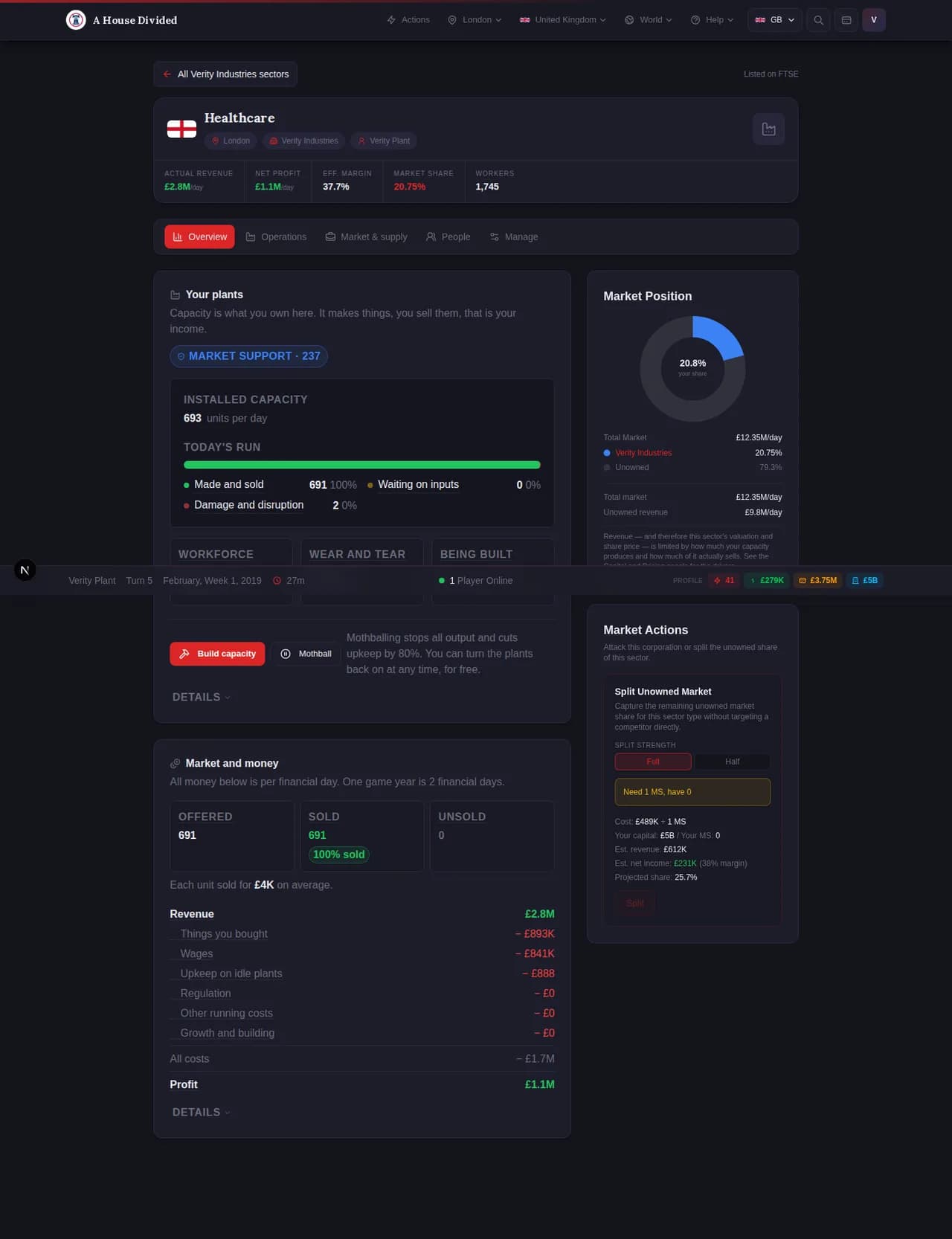
Today, a sector is a number you buy more of. Under the new model, a sector is a factory you build. You spend money on plant. It takes turns to come online. It makes goods, up to the size of what you built. Those goods go to market and some of them sell. What sold is your revenue, and revenue times margin equals profit on every row, because there is only one revenue and you can follow it from the plant to the ledger.
Why it matters:
- •You build the market. Untapped demand is not a number in a table; it is unmet demand, measured in goods, shown to you as somewhere to build. Where players choose to put plant decides what each market looks like, which means more variance from world to world and less of the market arriving preset.
- •Your plant explains itself. Each turn it tells you how much it made, how much sat idle, and what stopped it: short of energy, nobody buying, or a strike, each cause named with the units it cost you.
- •Costs are this turn's costs. Inputs are billed at what they actually cost this turn, so when the price of energy moves, your profit moves and you can see the line that did it. A blackout or a port closure stops production. Idle plant still costs money, the way a real factory would.
- •Growth is an order, not a slider. The build dialog shows what it costs and why, how long it takes, how many workers you will need, and how long it takes to pay for itself. It warns you when there is not enough demand in that market to sell what you are about to build.
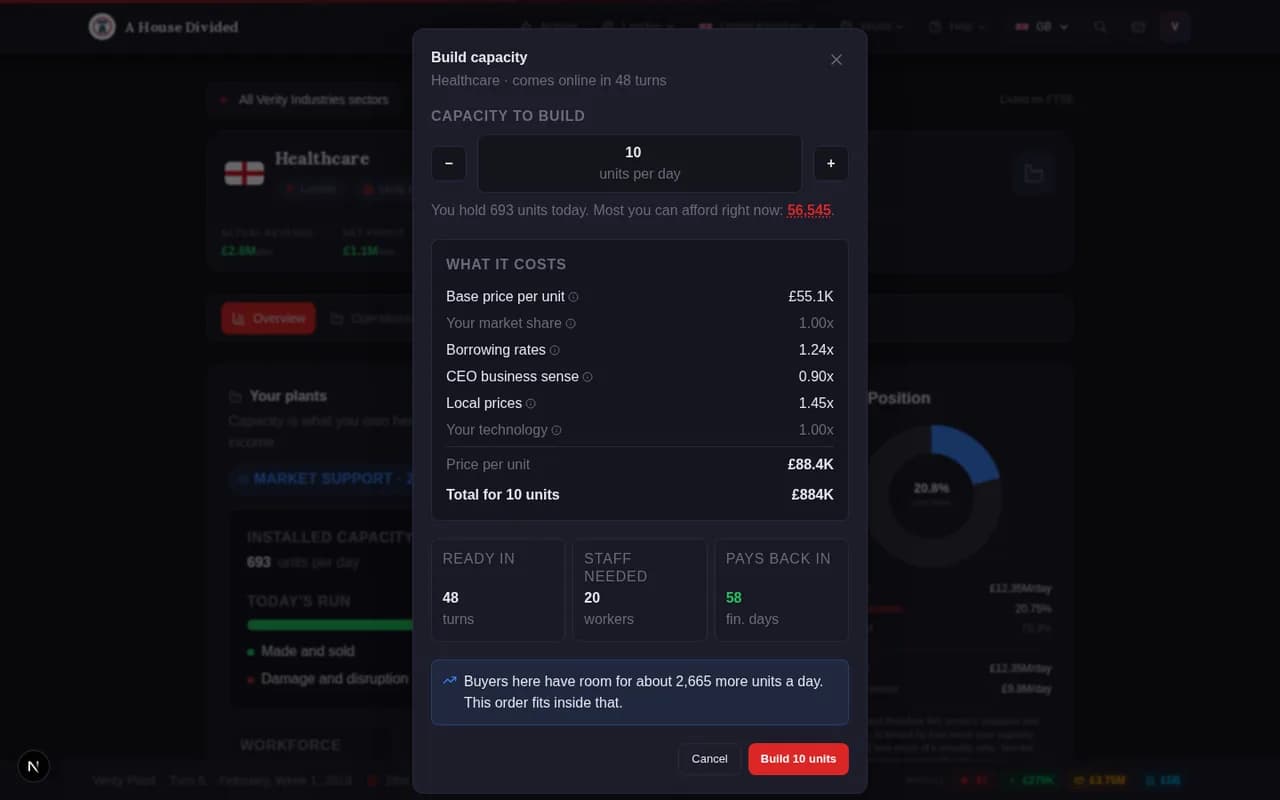
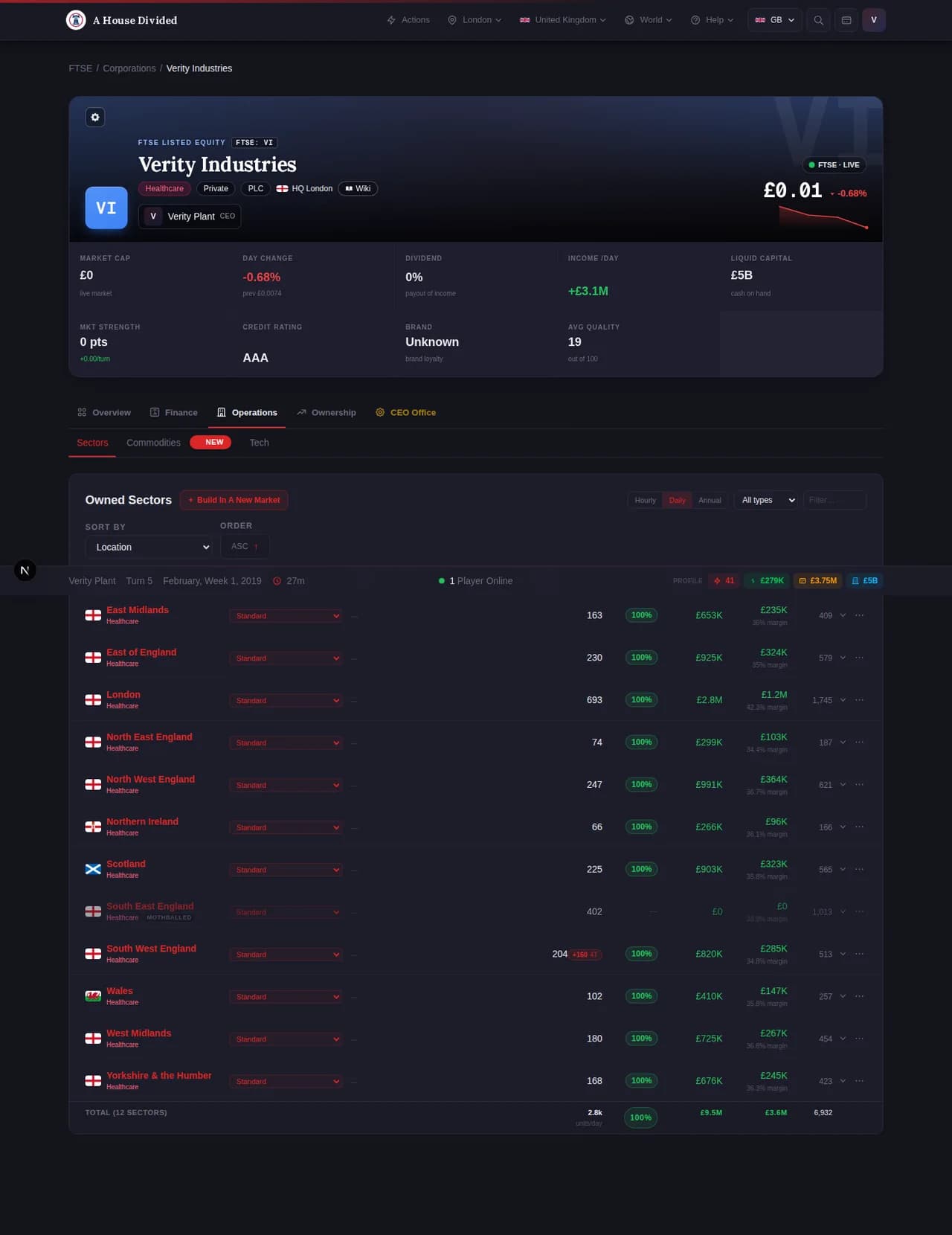
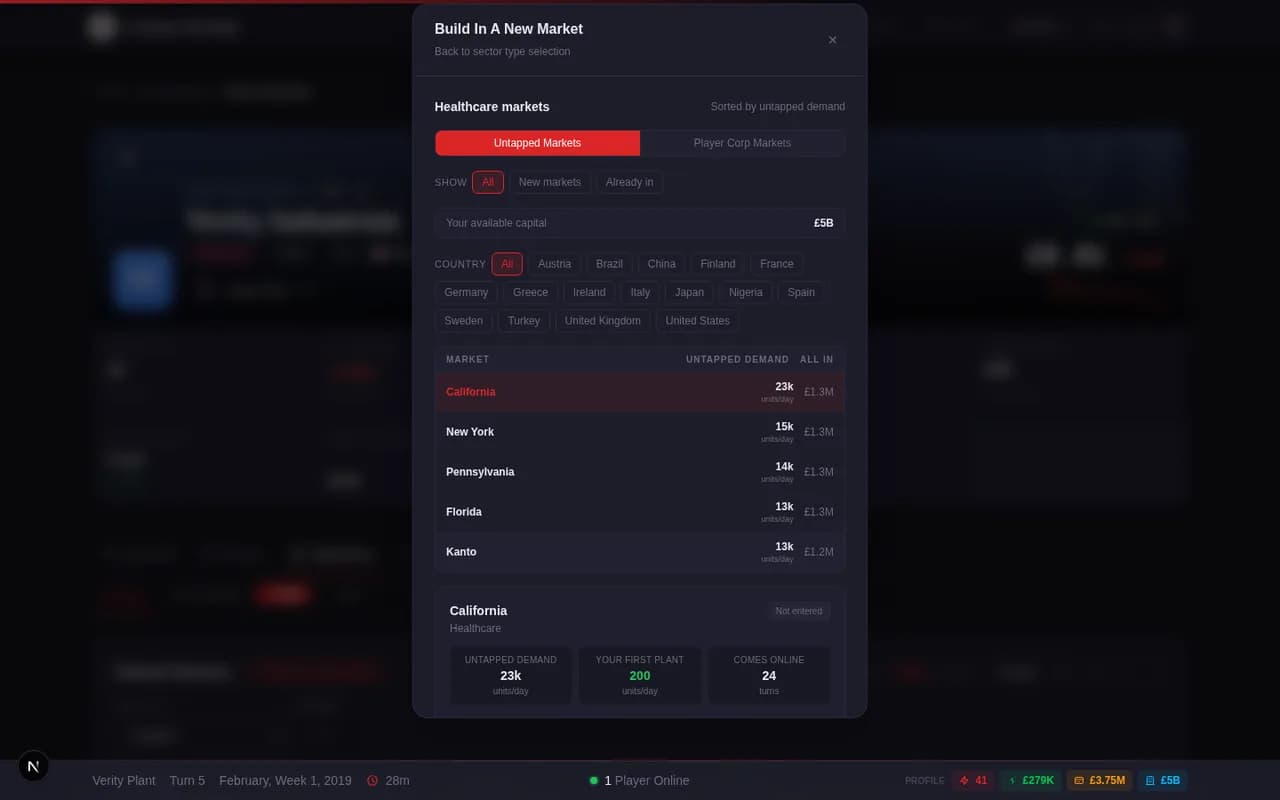
The idea came from the advisors channel, from a player pressing on how sector revenue relates to sector profit, and it grew into this. None of it is running in your game yet. The switch stays off until we have run the balance simulations, tested it in the sandbox, and had the advisors play it. You will hear about it here first, and the numbers in these screenshots, like the cost of a plant and how fast it pays back, are still being tuned.
Governing
- •Impeachment and by-elections. Presidents and governors can be impeached through the proper channels, and the vacancy is filled by a by-election.
- •Move to vacate the Speaker. Any sitting member files a motion, the whole chamber votes, and an absolute majority removes the Speaker on the spot. The motion is chamber-wide, so the minority can force the question.
- •The Speaker's chair refills itself if the Speaker loses their seat.
- •A Whip Room on the congress leadership screen.
- •Chamber rules with teeth. Cloture needs three fifths of the votes actually cast, state bills pass on a simple majority, and leadership positions reopen every cycle.
- •Electoral law is a channel you legislate in. Franchise and voter registration access are set by law, so who may vote, and how hard it is to register, is a decision your legislature owns rather than a constant.
- •The Warsaw Pact states have the offices they really had. A Chairman of the Council of State, a Chairman of the Presidential Council, a President of the State Council, a Chairman of the Presidium, each held automatically by the ruling party's chairman, the way the President of the PRC follows the General Secretary. Where a country has no such office, no office is shown.
A United Kingdom flavor pack
Authored institutional drama, mirroring the American electoral theater: party histories in the wiki, national and world wires, surprise judicial-review rulings, Lords revision delay, and a shared live Commons election night.
From the suggestion box
Player requests off the feedback queue, each checked against what already existed before anyone built it.
- •Move to vacate the Speaker. Above.
- •Debates are capped at three per candidate per election, so favour with non-player politicians is earned, not farmed.
- •Resign as a national corporation CEO, so an appointed CEO is never trapped in the seat.
- •Cancelled supply agreements move out of the way, behind a "show cancelled" toggle, with the record kept.
- •Supply deals can cross borders, and only target corporations with a human CEO who can actually accept.
- •Happy workers do better research. Paying above the baseline wage makes R&D spending more efficient; cutting below it makes it less.
- •Nationalise the little guys, keep the players. A sector takeover can carve out non-player holdings and the unowned market while sparing player-run companies.
- •Politicians drift with their states. Above.
End-of-season Wrapped
When a season closes, every character gets a personal recap: your biggest moments, your highest office, where you ranked in global wealth, and a shareable link with its own preview image.
New here?
An interactive tutorial walks new players through their first moves with a guided spotlight and a choice of starting track. Proposing a bill shows its projected annual cost up front.
Signing in, and the app
Sign-in moved to a shared identity broker with hardened token verification and a tightened return-URL allowlist, and Discord sign-in works. Behaviour is unchanged from where you sit, which was the goal. The Android app handles compressed responses, and ads no longer load inside it.
Also in this release
- •The world writes its own history. A chronicle extractor turns a world's run into a narrative report rather than a table of results.
- •Party rosters authored for the 1979 and 1991 starts across France, Italy, Spain, Sweden, Turkey, Greece, Finland, Austria and Nigeria.
- •Seat accounting corrected in the German Bundestag and the East German Volkskammer, and the UK's party organisation survives a reseed.
- •The corporation page is grouped like the state pages, and the stock market explains its IPO gate and groups state-owned enterprises by nation.
- •The in-game date reads as a month and a week, and holds still during founding.
- •Vietnam is divided on the map, cut at the 17th parallel.
- •Running for President is priced to the office, after a campaign-strength repricing pass.
- •A tidier menu, with collapsible categories ordered by where players actually go.
- •Supporter++, a new tier with a supporter wall and moderated requests. Existing Patreon and store subscriptions carry the same benefits.
- •Quieter improvements to how we spot people running multiple accounts.
- •Plus a long tail of fixes across the tutorial, corporation logos, and character creation.
- •Found Corporation on phone: the Cancel / Found buttons stay above the bottom status bar, and the starting-treasury field no longer shows a false red error on legal 1953 amounts.
Since launch
1.0 was a start, not a stop. The systems below shipped in the weeks after launch and are live in your world now, followed by the fixes for the players who hit them.
The Supreme Court convenes
The United States has a Supreme Court, and it is yours to shape. Nine seats, seeded for each era start with an authored roster of fictional justices; the game invents its jurists the way it invents its politicians, so no real judge's record is put in your hands.
Justices leave the bench on their own clocks. When a seat opens, the President nominates, a player or a generated candidate, and the Senate confirms, through the same kind of hearing window a cabinet pick gets. Fill the bench with hawks on one axis and you have changed what the law can become, because the docket is where it pays off.
Each era start carries an authored docket of landmark cases that come up for decision in their real years.
Authored docket cases, by era start
When a case fires, the sitting court decides it. A court that still looks like history rules the way history ruled. A court you have reshaped can rule the other way, and a diverged ruling is enacted like legislation: it moves the law, the law moves regional leans, and the shift lands on the nation's positions timeline (here is the American one) like any act of Congress. The Supreme Court can move your electorate, which is exactly the reason presidents fight over it.
Two deliberate limits. Race and equal-protection doctrine always resolves the way it really did; Brown v. Board is not a coin your court gets to flip. And alongside the authored docket, rare surprise cases spawn procedurally, era-windowed and never real cases, so a long-running world's court stays busy without inventing alternate history for actual litigants.
The court has its own page under the nation: composition and balance, the justice roster with portraits, the nomination pipeline, and the docket's history. Every ruling makes the news wire.
Declaring war, and making peace
War entered the constitutional order.
- •Declaring war is a bill. It needs two thirds of the chamber in every system of government, costs what a bill costs to propose, and carries a war goal from a fixed catalog: Conquest, Regime Change, Punitive, or Liberation. The goal is public, and it defines what winning means.
- •The executive holds the trigger. Passing the bill authorises the war; the executive's declare-war control starts it.
- •You can sue for peace. A peace offer is a real document with terms and an optional justification, open for 72 turns. The head of government or the foreign seat negotiates. An accepted deal stands both sides down.
- •Peace holds. A concluded peace binds the pair under a 240-turn truce, so a war cannot be re-declared the moment the ink dries, and a fresh declaration against anyone has its own cooldown.
Three more nations to govern
Finland, Austria and Greece are now full playable countries: governments, legislatures, elections, cabinets, parties and budgets, not map decoration. Austria brought its Bundesrat with it, and the engine learned to run unicameral legislatures to seat these parliaments correctly. All three read their eras: postwar Finland is paying off its war reparations to the Soviet Union, and Greece in 1953 has no head-of-state office to leave vacant.
The central bank gets a committee
Setting the interest rate stopped being one chair's private decision. Every central bank now seats a seven-member rate-setting committee, styled on the FOMC, with staggered terms and a published hawk-or-dove alignment for every member.
The committee meets on a cadence. The chair tables a motion, hike, cut or hold; generated members vote their alignment; player members get a twenty-four-hour window to cast theirs. A motion passes only on a majority of the full board, no-shows abstain, and turns never pause for a meeting. Rate moves are capped per term, so a captured board can tilt policy but not whipsaw it.
The seats themselves are political. The President nominates a player or a technocrat to any seat, including the chair, and the Senate confirms. Expired seats refill on their own, alignment flipped, so the board never runs short and never calcifies. The bank's FOMC tab shows the roster, the live meeting with its vote buttons, and the nomination form.
Sectors
- •A new sector could earn nothing. A sector founded after launch could build, staff, produce and sell while every money line read zero: a price was being derived from revenue the sector did not have yet, and the zero stuck. Prices now derive from what the sector makes. Any sector stuck at zero repairs itself on its next turn, and no capacity was lost.
- •Each output reports its own clear rate. A sector that makes more than one thing shows which product cleared and which sat, instead of one blended figure. Input availability reads from the world market, a shortage slows a line but never cuts it below half, and the panel shows the rate your plants ran at.
Command
- •Every conflict page tells you who you are in that war. A panel names the seat you hold, Theater Commander, posted general, defense secretary, or none of them, what you may do at that front, and for everything you may not, who does it and where to find them. It also explains how troops reach a front: a unit is wherever its general is posted, and the Commanding General posts generals to conflicts. The same explanation sits on the defense secretary's Commands tab, where the chain starts.
- •Recent offensives name the outcome, coloured from your own side's point of view whether the offensive was yours or the enemy's, and an unopposed advance is recorded as taken ground rather than leaving no trace.
- •New commands take fresh ids, so creating a command in a later session cannot silently edit an older one. Any organisation already affected repairs itself on page load.
- •A rare double-battle is gone. An offensive whose territorial update failed could be fought again the next turn, casualties and all. Resolution is now recorded safely.
- •Offensive odds stay on screen after you commit, while you decide whether to hold or call it off, and battle reports say what the fighting did to the front: ground gained, ground lost, or the line held.
Generals
- •Commanding a theater pays. A Theater Commander earns half of what a formation at that front earned, for every battle fought in their theater, measured per formation so a superpower's commander does not outrun a small nation's for the same work. If they led units too, they are paid for both.
- •Every trait costs exactly one point, promotions are worth four, and a commissioned general earns a point for every day of service, capped at twenty. An officer in a nation at peace still develops, and past the cap a general only grows by campaigning. A general who has reached Field Marshal keeps earning through war, up to fifteen more points. A maximal career buys 55 of the tree's 115 traits, a peaceful one 24; everyone specialises.
How much of the trait tree one career can buy
- •Winning battles is worth more experience, weighted so it helps small armies most. If you field one or two formations, a battle moves your general noticeably further up the ladder.
The Bank of England answers to the Chancellor
In every era start before 1997, the Bank of England has no operational independence, because it did not have any. The rate is set by the head of government or the Chancellor, the bank's page says so plainly, and there is no policy committee, because the MPC was created by the very act that granted independence.
Parliament can pass that act. An economy bill can carry a central-bank-independence provision: grant it and rate-setting moves to the Bank and its new committee; a post-1997 world can just as well revoke it and take the rate back. The statute is yours to write, which is the point. The calendar never flips it for you: a 1991 world that plays past 1997 keeps Treasury control until its parliament decides otherwise. Scotland and Wales share sterling and the Bank, so that decision belongs to Westminster alone, the way an ECB member cannot legislate over a treaty institution.
Central bank chairs come from nominations
The market pool is gone. A central bank chair used to be drawn 30% of the time from the nation's richest players, top-three wealth guaranteed a spot on the shortlist, and the "Potential Market Candidates" panel advertised it. Being rich is not a monetary-policy qualification, so the whole channel is removed: every chair now comes from the executive's nominations, lobbying only weights candidates who were actually put forward, and with no nominees the seat falls to a technocrat rather than to the wealth leaderboard.
Elsewhere
- •Eastern-bloc planned economies have state plants in every sector. A short "commanding heights" list left most industries with no state enterprise and an unreachable unowned pool (you cannot found private corps there). Every Eastern-bloc / Soviet sector now has a state enterprise with real plant capacity; the phantom unowned twins are gone.
- •A 1953 company is worth what it holds. Share counts now scale with the era the way money does. A corporation founded in 1953 issues about 143,000 shares rather than 10 million, so it opens at ten cents a share and a market value that matches the cash in its treasury. Before, the price hit the one-cent floor and the company opened worth roughly seven times what it actually held, which also meant anyone buying into its opening offer paid about seven times over. This covers every company the game creates: founded, state-spawned, spun off and privatised alike.
- •You can found a corporation in 1953 again. Founding was rejecting every attempt in a 1953 world, whatever your wealth: the form correctly asked for the era's $14,333, and the server was still checking the modern $1,000,000 behind it. The check now uses the era's own numbers, the ones you were shown. The cost summary also stops reporting a negative "extra treasury" when you found at the baseline.
- •The changelog stays up during maintenance. A down-window is exactly when you come looking for what changed, so this page now stays reachable while the rest of the game is sealed.
- •Era-correct offices everywhere. Greece's head of state is no longer reported vacant in 1953, an era where the office does not exist. Country pages read the era being played.
- •Tab strips scroll on phones, so Foreign Affairs, Regime Health and six other off-screen tabs are reachable on the White House, Cabinet, Supreme Court, Political Operations, currency and portfolio pages.
- •Currency Exchange leads with the nations you can play. The hero, main table and charts default to player-enabled currencies; everything else is one expand away, with market nations listed before planned economies.
- •Corporation tech follows a primary-type switch cleanly. Changing your corp's primary industry drops sector-lane research for the old industry (you re-research the new tree) and keeps shared corporate-lane unlocks, instead of leaving orphaned tech ids that made the Tech tab look reset.
- •Where a candidate stands now matters on two fronts. A state's economic and social leans are genuinely independent, so the 1953 South reads as economically left and socially conservative at the same time. Social positioning now moves votes on its own instead of echoing the economic lean.
- •Under plants, you build or take over — you do not split unowned. The first plant is one facility at an era-scaled entry fee, Build here opens the founding flow, and the old Split unowned controls are gone. Rival plant takeovers remain.
- •Build here keeps your state selected. Opening Build here from a region board pins that state in the expand list instead of jumping to the biggest market. Founding and first-plant placement still work while turns are paused for registration or settling — only an admin corp-actions pause freezes existing CEOs.
- •Companies outside the United States can build again. A British, Soviet, German, Chinese or Japanese company trying to open or split a sector was turned away with "invalid state ID", whichever region it picked — the server was checking the chosen region against a list of the fifty US states and nothing else, so no home region outside America could ever match. It now checks the region against your own country, which is what it meant to do all along. American companies are unaffected.
- •Staff can move you to your own country's regions. Asking a moderator to change your home region only worked if you played the United States — everywhere else the request was refused, and the admin tools offered no region to pick in the first place. Moving a character to a different country failed for the same reason, on every country except the US. Both now work for every playable country.
- •The FOMC Board of Governors shows who sits there. Technocrat members were rendering as Vacant even when seated; the roster now lists their names.
Your defence budget is now an actual budget
The defence line in your national budget used to be decoration. Armies cost nothing to keep, and a defence minister could buy divisions by borrowing against the treasury without limit.
Now it is an account. It fills every turn from whatever your laws currently set defence spending to — change the law and the new rate starts immediately, no waiting for a fiscal year. Your standing army is paid for out of it, and new units are bought from it.
A nation sitting at its historical starting force spends a little over half its defence budget just sustaining that force. The rest is yours to build with. Double the army and you are spending more than you take in.
Running short has consequences, and they are reversible. You can overdraw by up to a year's funding — enough to fight a campaign — and that becomes national debt. Past that, the troops you cannot pay start losing readiness, drifting down toward a lower baseline instead of holding at their posture's. Fund them again and they climb straight back. Nothing is ever lost permanently.
Growing your economy now buys you a bigger army. Previously it did not: unit prices rose in lockstep with GDP, so a booming economy bought exactly the same number of divisions. Prices now rise more slowly than the economy does, so industrial growth is genuine military strength.
The recruitment screen shows the account, what it nets per turn after upkeep, and — when you cannot afford something — how many turns until you can.
Your defence industry starts arming your army
Until now, equipment was a number your units were stamped with and nothing could ever change. A division raised in 1953 carried the same kit forever, and the defence companies in your economy built weapons nobody bought.
There is now a national arsenal, held separately for each arm of service — ground, naval, air, rocket, marine, space. Your own defence companies fill it under contracts you award as defence minister, paid for out of the defence appropriation, and new units draw from it when they are raised.
A starved navy is now something you can see. The arsenal shows what each arm holds against what your current roster would need to be fully equipped, so "the fleet is under-armed" stops being a feeling and becomes a number.
An empty store never stops you recruiting. A division raised with nothing in the arsenal arrives hollow — full strength in men, no equipment — and fills up over following turns as deliveries arrive. Scarcity costs you quality and time, never the ability to act.
Two different things now decide how good your equipment is. How much arrives is set by your industry's output — a bigger, better-run plant delivers more. How good it is comes from that company's research. An advanced arms industry with no production capacity gives you modern units with empty racks; mass production without research gives you fully-equipped obsolete ones.
For company owners: defence plants pick what they build the same way they always have, through their production strategy — and three new lines exist for naval, missile and aerospace work. A plant under contract earns real revenue per lot delivered, and researching further up the defence tree raises the quality it is allowed to supply. Contracts are domestic only for now.
Wars now cost equipment, not just lives
Fighting destroys materiel. A formation that comes out of a hard battle is not just thinned and shaken — it has lost equipment, and that equipment has to be replaced out of your national arsenal like any other.
That closes the loop: a war drains the arsenal, the arsenal is refilled by contracts with your defence industry, and those contracts are paid out of the defence budget your legislature votes. A long campaign is now a demand on your economy, not only on your population.
Armour protects your crews, not your tanks. A heavy formation takes fewer casualties than a light one — but a knocked-out vehicle is destroyed equipment either way, so armour does not make a formation cheaper to re-equip.
A beaten force is weaker next time. Equipment feeds combat power, so a unit that has been stripped and not yet re-equipped fights worse. Pulling a mauled formation back to refit is now a real decision rather than a cosmetic one.
Cabinet offices no longer share one cooldown across every setting
Changing one cabinet policy used to lock every other setting on that office for 24 turns. Health, Education, and Welfare was the obvious case: setting the healthcare model blocked the public-health campaign even though the two have nothing to do with each other. Each setting now has its own cooldown.
Founding a company now completes Your First Moves
Players who founded a corporation were stuck on "Take charge of a company" even while sitting as CEO. The checklist looked for an explicit CEO type that founding never wrote; newly founded companies stamp it, and existing player-run companies without it now count too.