1.19: Every sale has a buyer
The economy now runs on a market where every sale has a paying buyer, and the plants, prices and banks underneath it were reworked to hold up. Campaign Manager puts every down-ballot race on one page, Ask Keir is open to every player, the wiki was rewritten, and pages load far faster.
Dev diary by the Lakeside Games team, 3 November 2026.
TL;DR
- •Changed: the economy was rebuilt on a market where households, governments and companies pay real money for every unit they buy, and prices follow real shortages.
- •Changed: plants run what they can staff, supply and sell, instead of freezing when cash runs short or paying a full crew for output they never made.
- •New: Campaign Manager puts every race below the presidency on one page, with maps down to counties and every campaign action in reach.
- •New: Ask Keir is open to every player, works properly on phones, and has a much larger allowance.
- •New: party chairs can introduce bills through their party's seated legislators, and a Labour migration law arrives in the US, UK and Japan.
- •New: singleplayer gets save slots, autosaves and multi-turn play.
- •Changed: the wiki was rewritten system by system, with diagrams, live charts and real screenshots.
- •Changed: pages download about two thirds less code before they work, and the hourly turn does far less work.
- •Fixed: banks that should never have failed are reopened, and the bond market no longer creates money.
The story
For most of the game's life, companies sold into demand a formula produced, and nobody actually paid for a good part of it. 1.19 ends that. The world's companies and markets were rebuilt from the era seed, every politician got one chance to choose the wealth they start with, and the turn moved to a market where every sale has a buyer spending money they really have: households from wages and profits, governments from budgets, companies from their own cash.
A market like that is less forgiving, and it found every place where the old rules still assumed free money. Plants froze the moment a company spent its cash on construction. A plant short of one minor input idled most of its capacity. Automatic prices sat far above the market and sold nothing. Most of this release fixes those, one by one, until a well run company behaves the way you would expect. The banks got the same pass: central bank injections were charging private banks interest and pushing some under, and the bond market was refilling itself with new money every turn.
The other half of 1.19 is about finding your way. Campaign Manager, Ask Keir for everyone, a rewritten wiki and a new navigation layout for experimental players all aim at one problem: too much of the game was hard to reach or hard to understand from inside it.
The new market
Real buyers, real prices
- •Prices move with what buyers actually ordered and paid. A real shortage raises the price every turn it lasts.
- •Automatic pricing asks around last turn's market price, and your pricing posture sets the markup over it.
- •Your own sites get your own output first, nearest site first, before any outside buyer. This is now switched on.
- •Construction trades across your whole country, and new trucking fleets arrive in 15 turns instead of 36.
- •Targeted embargoes now actually stop the goods they name.
Plants that keep working
- •A company short of cash runs the plants it can staff and supply, can carry wages on short credit, and can pay a plant's costs out of that turn's sales.
- •Plants pay wages and site costs only for what they produce. A plant that makes two products follows the one that sells.
- •Open jobs fill in a turn or two where people are looking for work.
- •State-owned national corporations are funded by their government each turn and run their plants again.
- •AI companies build what is actually short and answer every supply proposal with a counter-offer or a reason.
- •Plants are now built, owned and worn out whole. A sector holds a whole number of plants, a large build delivers its plants one at a time, and wear closes a plant only once a whole plant has worn out.
Reading your company
- •Company screens count plants: how many you own, how many are on order, when the next one lands, and how much you ran and sold.
- •The sector page shows unsold output and real losses, and names output that went to your own sites.
- •Build capacity in up to 50 sectors at once from the CEO Office, with every price shown first.
- •A parent company can retool and rebrand an AI-run subsidiary.
- •Share prices follow what a company actually earns, and no longer drift down and then leap for companies one owner controls.
- •New shares sold to the market pool are priced against the company's real value, and your own company's shares count toward your credit line at no more than half their price.
Money, banks and tax
- •Central bank injections no longer charge interest. Banks closed by that interest, and one closed after the withdraw page overstated its spare cash, are open again.
- •Banks can no longer withdraw money they do not have, and governments refinance a maturing bond they cannot pay so holders are paid on time.
- •Paying in another currency always converts enough, and a failed purchase gives the conversion back.
- •You can sell shares to one named player at any agreed price. The deal is shown publicly on the Shares tab.
- •Personal share sales withhold tax on the profit up front, and bond interest a company pays is deducted before corporate tax.
Elections and government
Campaign Manager. The Actions tab is now Campaign, holding your actions and the new Campaign Manager. Filter races by type, stage, region, year and party, open a map down to counties, constituencies or districts, read the seat's earlier races, and boost, attack, barnstorm or endorse without leaving the page. Old down-ballot links open the race there; the presidential page is unchanged.
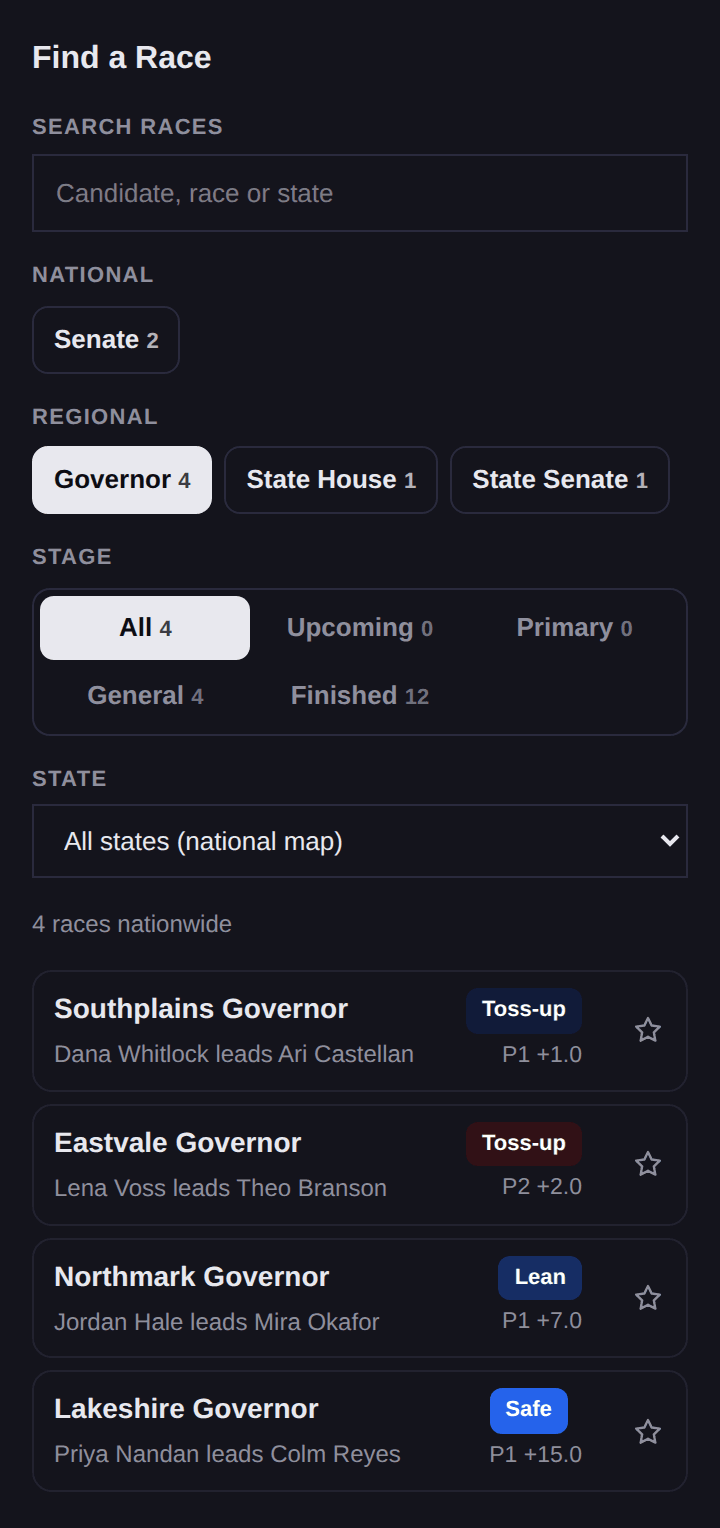
- •House races decided by district show the votes you need for your next seat.
- •General election phases last 24 turns, and a coalition chair can nominate a Prime Minister from any coalition party.
- •Party chairs can introduce national and regional bills, and file impeachment articles, through seated party legislators. Subsidies are back in the bill builder.
- •Entry and residence now changes how many migrants arrive, and the new Labour migration law sets work visa intake.
- •Cabinet actions need the minister who holds the seat, and a nominee blocked by a central bank office can choose between the two.
Getting around
- •Ask Keir is on for every signed-in player. On a phone it opens full screen, and it can draft a suggestion or a support ticket for you. Questions use energy instead of a daily count, with roughly four times the old allowance.
- •Crises, debates and random events share one Events panel on the Actions page.
- •Alerts carry only what needs you, and "sending requests too quickly" errors are far rarer.
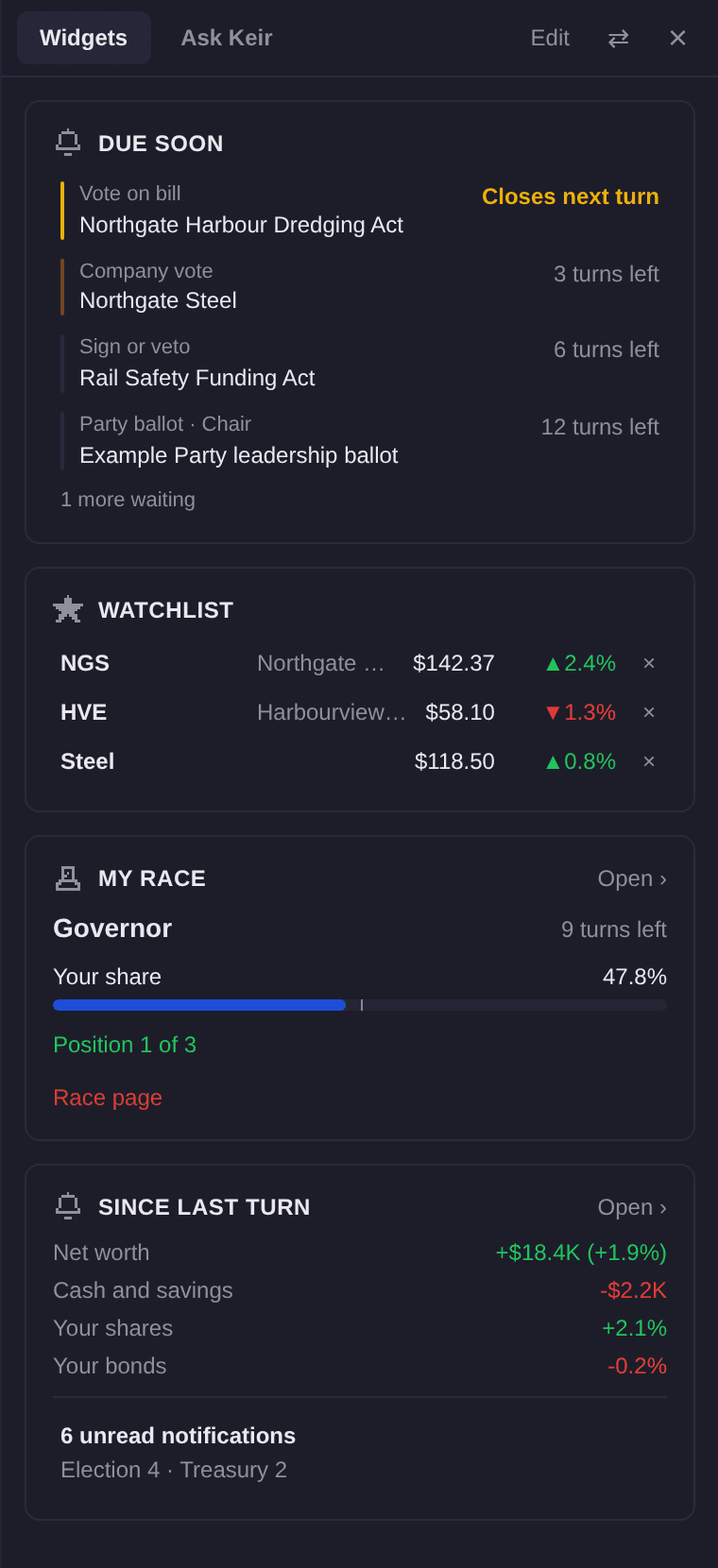
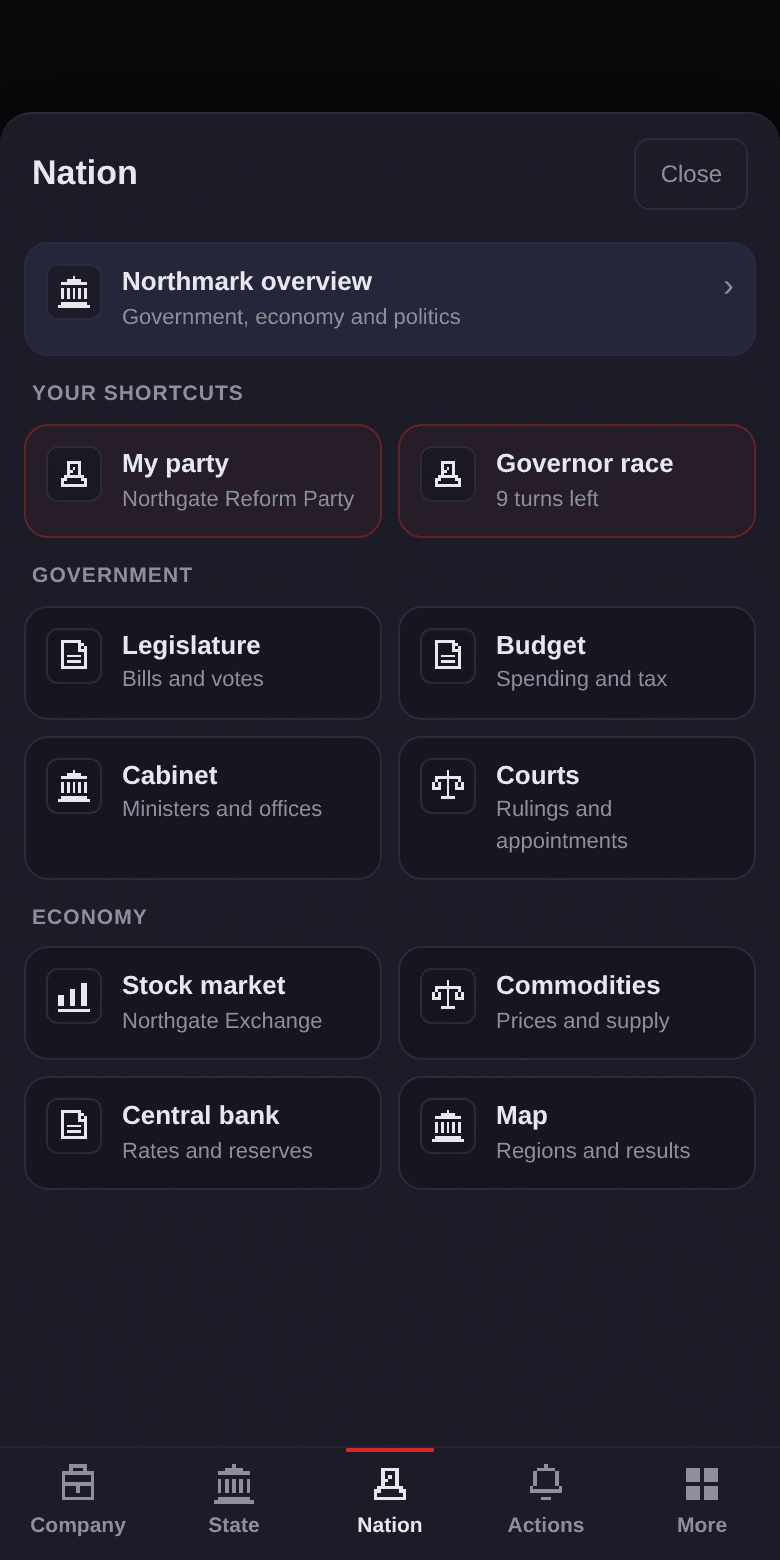
With Experimental features on in Settings, you also get a side tray of widgets (Due soon, Watchlist, My race, Chamber floor, My office and more, with Keir at the top offering a tip and a cup of tea), grouped card menus on desktop that you can pin and reorder, and a bottom dock on phones.
The wiki
Every system page was rewritten around the decisions you make in it: the numbers you plan around, a worked example, what you can do, and what it affects. Pages gained step by step diagrams, charts drawn from the live game numbers, and screenshots of the real screens. A full check against the game corrected numbers on 97 pages.
Singleplayer and apps
- •Save a local world under a name, load any save, and keep the last three autosaves.
- •End turn can play 3, 5 or 10 turns in a row, stops early when something needs you, and summarises what happened.
- •A new Career world offers a short getting started guide.
- •Local turns are faster, saves survive game updates, and worlds open every time on desktop 2.8.0.
Faster everywhere
The code a page loads before it works is about two thirds smaller, with the biggest gain on phones; a corporation page now arrives in a few kilobytes instead of nearly a megabyte. The hourly turn stopped rereading history it never uses and settles payments in batches, so trading reopens sooner after each turn.
Fixed in this release
- •Continue with Discord signs you in again.
- •Posts and names that mention Niger, Guinea or Papua New Guinea are no longer refused.
- •A dividend can no longer pay out more than its pool.
- •A retooling mine is no longer charged a build toll as if a trace of its old product made it dominant.
- •Unions were reset with the economy, and a union head can always resign.
- •Bulgaria's founding runoff keeps its candidates.
- •Moderators can block a device from creating new accounts.
Still rough
Electorate group priorities are shown for information only and do not move votes yet. The side tray, grouped menus and phone dock stay behind Experimental features while we finish them, so expect them to change.