Rosenburgh, Inc.
Rosenburgh, Inc. (commonly abbreviated as ROSEINK) is a multinational media, publishing, and entertainment conglomerate headquartered in Kildare. Founded by A. R. Watson, the company oversees a vast network of media properties through its subsidiary TruthWave Media, Co. The corporation is known for its extensive fictional mythology surrounding "The Wave," "Paradise," and the literary movement known as The Wave Eternal.
Originally established in the Chūbu region of Japan, Rosenburgh later relocated its headquarters to Ireland following political controversies involving its founder. Throughout the twentieth and twenty-first centuries, the company expanded into television, film, publishing, news broadcasting, animation, interactive media, alternate reality games (ARGs), and community-driven literature.
The company maintains a distinctive corporate philosophy centred on truth, preservation, unity, and information control. Its branding frequently incorporates nautical imagery, waves, roses, ink, quills, and themes of voyages toward a mythical destination known as Paradise.
Appearance
Rosenburgh, Inc., often referred to simply as ROSEINK, is an Irish-Japanese multinational media corporation founded by A. R. Watson, known internally as the Forever Founder and Perpetual Director.
The corporation's official motto is:
"A World Preserved For Purity."
Its logo depicts an ink quill and inkwell accompanied by the corporate slogan. The organisation oversees publishing houses, television networks, entertainment studios, digital media platforms, and literary communities through numerous subsidiaries, most notably TruthWave Media, Co.
According to corporate records and company mythology, Rosenburgh began as a small publishing and communications venture in Chūbu, Japan, during the early twentieth century. Under Watson's leadership, the company expanded rapidly through serialised fiction, newspapers, literary journals, and later broadcast media.
A defining feature of the corporation has been its fusion of commercial entertainment and fictional mythology. Throughout its history, Rosenburgh has encouraged audiences to engage with a shared narrative universe revolving around concepts such as Paradise, the Wave, the Eternal Voyage, and the preservation of truth.
History
Origins in Japan
The earliest known records of Rosenburgh trace its origins to Chūbu, Japan, where A. R. Watson established a small publishing operation.
Watson quickly gained notoriety for his charismatic leadership and unusual philosophical writings. One of the earliest surviving excerpts attributed to him, dated 5 August 1917, describes the mythical destination known as Paradise:
"There is a safe haven beyond, a paradise for those who are sick and tired of this meaningless noise that encompasses such corroded communities..."
The speech became one of the foundational texts of the later Wave mythology and remains widely quoted by followers and literary enthusiasts.
The Night of the Lost Tides
A major event in Rosenburgh mythology is the so-called Night of the Lost Tides, commemorated on 19 October 1917. On this date, Watson allegedly completed a symbolic expedition that inspired his essay The Return to the Mainland. The document describes the discovery of a remote island named Murus finalis ("The Wall of the World"), portrayed as both a physical location and a metaphorical frontier between ignorance and enlightenment. The text later became one of the most influential works within the company's expanding fictional universe.
Relocation to Ireland
During the late twentieth century, Rosenburgh became embroiled in political controversy within Japan. Reports and allegations connected Watson to activities involving Japanese communist political organisations. Additional accusations claimed that the Rosenburgh media outlets had participated in slander campaigns against political opponents and critics.
Although no definitive consensus emerged regarding the extent of Watson's involvement, the controversy contributed to his decision to transfer citizenship and relocate the corporation's headquarters to Kildare, Ireland.
The relocation marked the beginning of what company historians describe as the Second Foundation , characterised by aggressive expansion into international media markets.
Corporate Structure
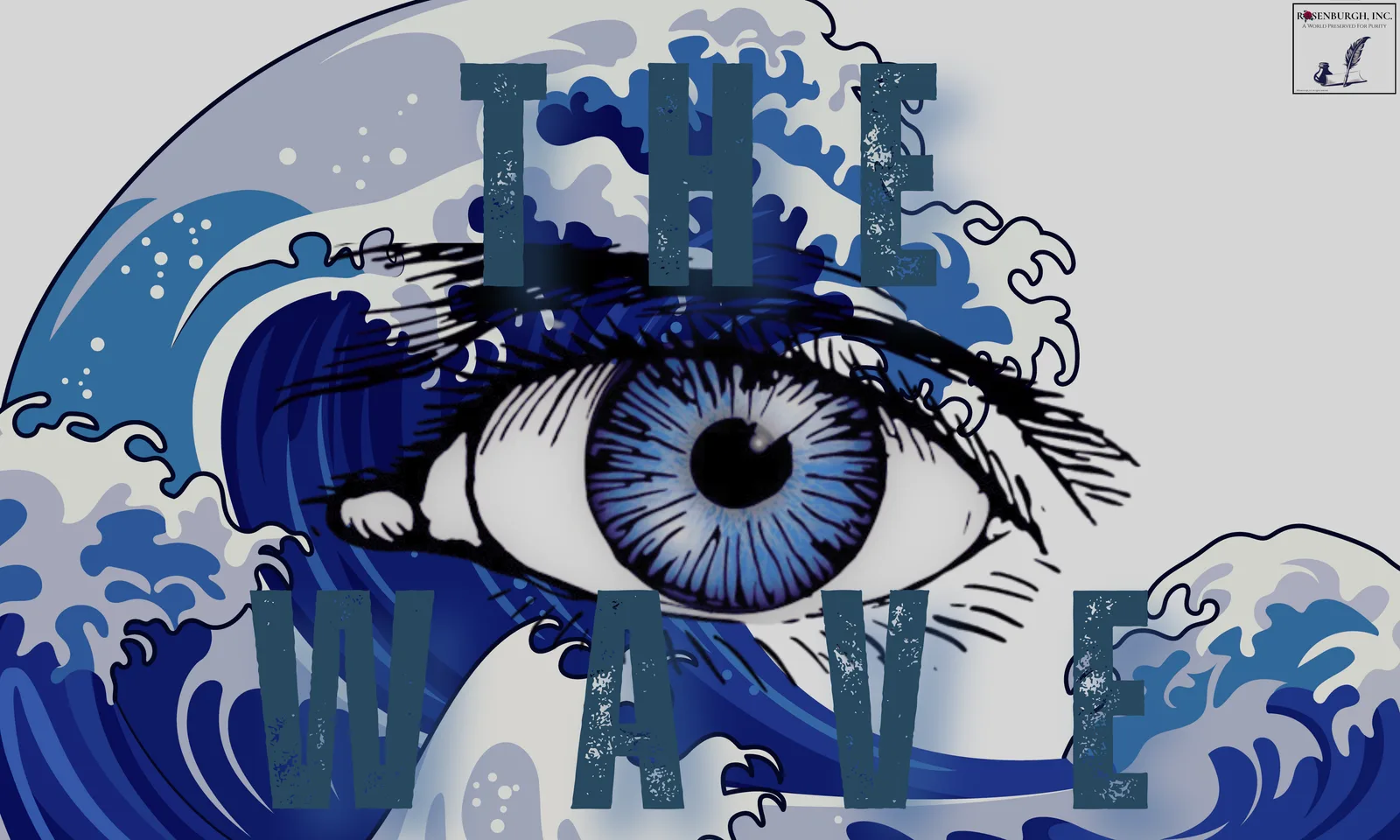
Rosenburgh operates through numerous subsidiaries, divisions, and affiliated organisations. TruthWave Media, Co. serves as Rosenburgh's principal production and broadcasting subsidiary. Its official logo consists of an eye enclosed within a stylised ocean wave, based on "The Great Wave Off Kanagawa," symbolising observation, knowledge, and the flow of information.
TruthWave produces television programming, feature films, news broadcasts, children's animation, corporate educational content, interactive media, audio productions, and ARG experiences. The company is widely regarded as the public face of the Rosenburgh conglomerate.
The Wave Philosophy
The corporate mythology surrounding The Wave developed gradually throughout the twentieth century. According to Rosenburgh's literature, the Wave represents truth, purification, unity, order, and the preservation of knowledge.
The concept is frequently contrasted against what company writings describe as "corrosion," "noise," and "fracture." Many Rosenburgh productions reference a mythical destination called Paradise Beyond, often depicted as a distant refuge beyond chaos and misinformation.
The Divine Providence of the Wave
One of the most notable cultural phenomena associated with Rosenburgh is the emergence of a fan movement known as The Divine Providence of the Wave. Originally beginning as a literary and artistic community, the movement gradually evolved into a large international fandom centred around Rosenburgh's mythology.
Members frequently create poetry, fiction, music, artwork, historical reconstructions, and a multitude of ARG participation projects. Although outsiders have occasionally described the movement as cult-like, participants generally characterise it as a collaborative artistic community.
The Wave Eternal
The most influential creative organisation to emerge from the Providence movement is The Wave Eternal. Founded by individuals referred to in company literature as "Voyagers," the group specialises in community-written stories, poems, hymns, and worldbuilding projects inspired by Rosenburgh mythology.
One of the group's most famous compositions is March of the Rose & Ink (The Heavenly Voyage), a sailing hymn celebrating exploration, perseverance, and devotion to the ideals of the Wave. The hymn remains a recurring feature at fan conventions, literary gatherings, and company-sponsored events.
Media Properties
Confession At Last!
Confession At Last! is TruthWave Media's oldest and longest-running television production. The series has aired more than 900 episodes, first released in 1984, and follows the life of a young boy as he grows into a respected public figure and role model.
Major themes include honesty, responsibility, family, legacy, personal sacrifice, and the pursuit of truth, while having a weekly twenty-minute-long feature whereby an employee of the corporation would often admit to an embarrassing story through what became known as The Trial By Admission.
The series became one of TruthWave's most commercially successful programmes and is frequently cited as a defining example of the company's ideological storytelling style. Other notable media properties owned by Rosenburgh, Inc. are: In & Out the Rolling House, Around the Peeping Hole, A Mind of Empire, All Along the Way, Despite the Compromise, and The Wistful Tears.
Leadership
A. R. Watson serves as the sole executive authority of Rosenburgh. Throughout the corporation's history, Watson has maintained majority control over voting shares and strategic decision-making. Numerous accounts from former employees describe a highly centralised management structure in which advancement depended heavily upon loyalty and adherence to corporate values. Watson's leadership style has been characterised by supporters as disciplined and visionary, while critics have described it as authoritarian.
Among his most frequently cited statements:
"Your innocence is only defined by what you do, by the divine judgement of the Wave."
Public perceptions of Watson have varied significantly over time. Supporters frequently portray him as a visionary entrepreneur, a literary pioneer, a media innovator, and a defender against misinformation. Critics, meanwhile, have accused him of excessive information control, corporate authoritarianism, political manipulation, and cultivation of personality.
Popular folklore surrounding the founder often exaggerates his influence, leading to legends describing him as: "The Man Who Never Ages," "The Perpetual Director," and "The Calamity of Falsehood".
These nicknames have become deeply embedded within Rosenburgh's public mythology.
Themes and Ideology
Many Rosenburgh productions share recurring themes, including truth versus misinformation, order versus chaos, exploration and voyages, preservation of history, community unity, moral discipline, and literary immortality.
A recurring concept appearing throughout the corporation's works is the notion of "Faultines," a fictional social disease representing ignorance, hostility, and self-destructive behaviour.
An excerpt attributed to Watson states:
"Faultines are the disease that rots the brain, turns people into savages..."
The concept has since become one of the most recognisable symbols in Rosenburgh's fictional universe.
Legacy
Rosenburgh, Inc. remains one of the most influential entertainment organisations within its fictional setting. Through television, publishing, music, games, and collaborative storytelling communities, the company has transformed its corporate mythology into a worldwide cultural phenomenon.
Its symbols—the Rose, the Ink, the Wave, the Quill, and Paradise—continue to serve as defining icons of the ROSEINK identity, while A. R. Watson remains both the architect of the corporation and the central figure around whom its mythology revolves.